Sunday, August 30, 2020

Sourdough Apple Cobbler

It's apple season here in West Virginia and the magazines are full of recipes made with apples. This filling is made with a double dose of local apples-mixing the apple chunks with apple butter made the day before with the same apples! This one has a drop biscuit dough made with a sourdough starter-but you can add any of your favorite cobbler toppings.

Apple Butter Cobbler 

(Serves 8)

Filling
Toss apples with brown sugar and flour.
42 ounce apples, peeled and cut in 1/2 inch pieces
3 tablespoon brown sugar
3 tablespoon whole wheat flour

Melt butter in 12 inch skillet on stove top.
2 tablespoon 2 teaspoon buttery spread
Add apple-sugar-flour mix. Cook over medium low heat for 10 minutes, stirring often.

Remove apples from heat.  Stir in apple butter
2/3 cup slow cooker *apple butter (made with simply apples, cinnamon, nutmeg and cloves)

Add lemon zest, juice and salt. Stir.
1 teaspoon lemon zest
4 teaspoon lemon juice
1/8 teaspoon salt
Place apples in 9 inch baking dish. Place baking tray under dish to catch juice overflow.
Bake at 425 F for 15 minutes. 

Drop Biscuits
Mix flour, salt and baking soda in small food processor.
1/2 cup whole wheat flour
1/8 teaspoon salt
1/3 teaspoon baking soda

Add butter to processor, pulse about 45 seconds to mix.
2 tablespoon 2 teaspoon butter, cut in small pieces

Add buttery flour mix to sourdough starter and stir. Add milk to thin.
1/2 cup sourdough starter
2 tablespoon nonfat milk

Drop dough onto top of apples using a 1 tablespoon scoop.
Sprinkle with cinnamon sugar. 
Cinnamon Sugar
Bake at 425 F for 18 minutes, reducing heat by 25 degrees if necessary to prevent over browning.

Serve warm with vanilla ice cream!

*For the apple butter, I peeled and cut 2 1/2 pounds of apples in 1/2 inch chunks. Mixed in 1/2 teaspoon cinnamon, 1/4 teaspoon nutmeg and 1/8 teaspoon cloves. Cooked on high in slow cooker for 3 hours. Blended when cooled.


Saturday, August 22, 2020

Merging Health into 21st Century Menus

Equipment upgrades, service awards and nutrition labels spotlight enticements to the Health Sciences Center Cafeteria in the early 2000s. 

Over a long weekend in January of 2005, aging serving area equipment was replaced with custom ceramic tile furnishings and black outlined sneeze guards. Thanks to a dedicated Facilities Staff, service was not interrupted.

The entire HSC Cafeteria Staff was recognized by hospital administration, each receiving a quality award. A favorite activity of the staff was a trophy award, given by peers and passed to another team member monthly. Each outgoing awardee gifted personal items-like bubble bath and flowers-to the new recipient.

Community outreach included booths at the annual Health Fair-the first focusing on sanitation, hand washing and protecting hazardous foods.

By 2004, nutrition labels accompanied all menu items at point of service. Since most items were made from scratch, and nutrition labels were not required on institutional packaging-this was no easy feat. The nutrition labels also listed ingredients.

In 2007, the cafeteria was recognized by the Whole Grains Council as a leader in Healthcare. Whole grains were purchased from a nearby farm, with whole wheat and whole corn meal grown and ground on site. Desserts and muffins were made with half whole grain flour. Whole grains, like Kamut, quinoa, oat groats and bulgur were made into entrees, sides, salads and soup. Brown rice replaced white across the menu.

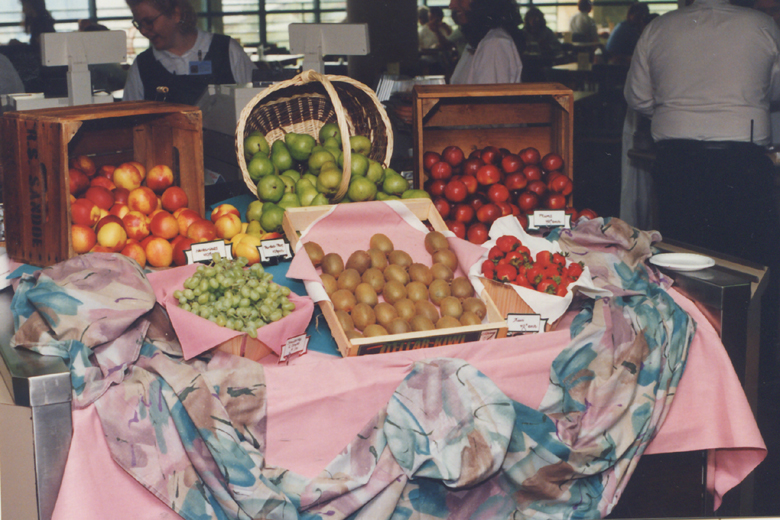
Seasonal fruits and vegetables were served daily. The popular salad bar featured 24 colorful fruits and salads-all (except spinach) cleaned and cut on site.

Dried beans were cooked on site and made into salsas, soups, salads and hummus. The vegetarian bean soup sold for 25 cents less than other soups.

Because made from scratch menu items were nutrient dense, these were easy to combine as meal deals to fit into low to moderate calorie plans with less than 500 mg sodium per meal. These complemented guidelines for My Plate and the New American Plate. The few processed snack foods available were sold in smaller packages. Deli sides included a grainy item and a traditional item. 

We were lucky to have a customer base that wanted to choose healthy-students, faculty and staff in health professions. Yes there were naysayers, yet there was something for everyone. It wasn't about forcing customers to choose healthy-it was about enticing them. That took a productive, committed and customer oriented food service staff to achieve.

Martha Nesser, a mentor, was a local wellness champ. She taught us to promote the good things we did and to practice good sanitation techniques. This is her recipe, a favorite of the Health Sciences Center Cafeteria and served to her family of 13:

Martha's Vegetarian Chili

(Serves 6)

2 1/2 cups cooked pinto beans

Place bulgur wheat in bowl. Heat tomatoes to boiling and add to the bulgur wheat. Stir and let stand approximately 15 minutes.
1 cup bulgur wheat
14 ounces diced tomatoes, canned in juice

Heat remaining ingredients in kettle and simmer. 
1/3 cup onion, diced
2 cloves garlic, minced
1 cup green pepper, diced
1/4 cup celery, diced
1/4 cup carrots, peeled and diced
6 ounces tomato paste
2 1/4 cups water
2 teaspoon basil
2 teaspooon chili powder
1 teaspoon cumin
1/4 teaspoon cinnamon.

Just 15 minutes before serving, add bulgur/tomato mixture and beans.  Keep hot for service.
    

Sunday, August 16, 2020

Reliving Food Service in the 90s

I spent much of my career in retail services, working as a manager for the university hospital. In the early 90s, the focus was on changing the institutional image to one of retail. Employees wore chef coats and hats to carve turkey and beef on the serving line. 


Cakes were baked in round pans and cut in wedges instead of squares. The made to order deli line with carved bread was a popular station. 


"Individual" round pizzas were baked in a conveyor oven at service. Stainless steel serving containers were replaced with black bowls and pans. Stainless steel tables were covered with linen.

I was fortunate to work in health care where fruits and vegetables were always encouraged. Most of the entrees were made from scratch. In the low fat era of the 90s, we served lots of boneless skinless chicken breasts. We offered daily selections of low fat desserts, even reducing the added sugar. Whole grains were limited to whole wheat bread on the deli with white rice and pasta the staples. The jumbo craze extended to muffins and bagels-like the "individual" pizzas, 2-3 times the recommended serving size, with little fiber.

We purchased our first espresso machine which proved to be so popular, it now has it's own cafe. A panini machine was added to the deli in the snack bar.

The 90s brought layoffs in the supervisory staff. When I moved to the Health Sciences Center in 1997, I went solo. The merchandising skills I'd learned proved valuable when improving the surroundings in the run down 50 year old cafeteria. Customer service was the focus in eliminating the 1/2 hour cafeteria shut down between breakfast and lunch, the same time the facilities staff took their lunch break.

In the 19 remaining years I managed that cafeteria, I blended my nutritional knowledge with the service and merchandising skills. Every year I made a change, based on current nutritional recommendations, to encourage customers to make healthy selections. What I'd learned is that doesn't just focus on the menu, but also the service and the surroundings.

It was in the 80s when local restaurateur, Joe Sesisto, shared his Vegetable Lasagna recipe with us. It was one of many heart healthy recipes the American Heart Association endorsed. Well into his 90s, he came back to share that recipe with us. I did not save but a few from my 37 years at the hospital, but this one was a keeper because his memory I want to cherish.

Joe's Vegetable Lasagna

(Serves 12)

10 each uncooked lasagna noodles
12 ounce zucchini, sliced and quartered
8 ounce carrots, sliced in rounds
4 ounce green peppers, 2 inch strips
1 pound whole tomatoes, cubed
6 ounce cauliflower, 1/4 inch slices
6 ounce broccoli, 1/4 inch slices
1 pound low fat cottage cheese
12 ounce part skim mozzarella cheese
1 pound 12 ounce pizza sauce
3 3/4 ounce Parmesan cheese


Spray no-stick product on baking dish.  Place a layer of noodles on bottom of pan.  Arrange the following in layers in the pan.  1 cup cauliflower, 1 cup carrots, 1 cup tomatoes, ½  cup peppers, 1 ½ cup broccoli, 1 ¼ cup zucchini, ¾ cup cottage cheese, ¾ cup mozzarella cheese, 1 ½ cups pizza sauce, ½ cup Parmesan cheese.  Add another layer of noodles and repeat step # 3.  Cover pan with foil which has been sprayed with no-stick product.  Bake at 350 degrees for 1 ½ hours.  Cut lasagna 3 x 4 and serve.
 

Sunday, August 9, 2020

A Plum Job

Yes, I like everything about the plum- the color, the texture, the taste. Plums are in season now locally-though, because they aren't the easiest to grow near my hometown, we travel about 200 miles to the Western Maryland Mountain town of Thurmont to visit an orchard where the produce is prime. Pryors Orchard has Santa Rosa plums now at their peak. In their open market, they pick and pack the produce by hand. With the COVID restrictions, masks are required and the workers do the handling. 

Plums are good sources of soluble fiber and Vitamin C. They have a low glycemic index and phytochemicals, that may function as antioxidants in our diets.

The sourdough "upside down cake" pictured above is a recipe from Valerie at Beets and Bones.  The cake is made with my whole rye sourdough starter, Kamut and spelt grains. Since I grind my grains at home in the counter top flour mill, this recipe had my name on it. This recipe is whole grain, without much added sugar. The grains are good sources of iron, magnesium, the B vitamins, Manganese and Selenium. Whole grains are good sources of fiber, combined with that in the plums-we have a winner!

I made these mini plum cakes earlier in the week when I only had 1 plum.

Mini Plum Cakes

(Makes 4 individual servings)

Beat sugar and egg well.
1 egg
3 tablespoon sugar

Cream with butter.
5 Tablespoon butter (at room temperature)

In a separate bowl, mix almond meal, baking powder, salt and flours. Stir in grated lemon.
3 Tablespoon almond meal
5/8 teaspoon baking powder
Pinch salt
1/2 cup spelt flour
3 Tablespoon whole wheat flour
Zest from 1 lemon

Mix yogurt with lemon juice.
1/4 cup nonfat plain yogurt
1/2 teaspoon lemon juice

Alternately add dry flour mix to mixing bowl with liquid ingredients. Mix just until flours are incorporated. Divide into small baking dishes or muffins cups. (about 1/4 cup batter each).

Mix plums and remaining almond meal.
1 large plum, seeded and chopped
1 Tablespoon almond meal

Sprinkle over top of each baking dish.

Bake in 350 F oven for 30 minutes.

 I will make the Plum Clafouti later when only the smaller plums are available.

Friday, July 31, 2020

Rye Renditions

Considered a weed, rye was deemed the poverty grain. It grew where other grains could not survive, in cold and wet areas. Rye was grown in New England during colonial America and on soil that could not support wheat-the Southern coast and mountain interior. While it grows here in West Virginia, my farmer-miller friend quit growing it when consumers didn't buy the flour.

Why rye said I? Rye has fiber throughout the kernel-in the endosperm, bran and germ. With a lower glycemic index than many grains, it helps to keep one feeling fuller longer, controlling weight and diabetes. To me, it's the variety in grains, produce and protein that I choose to keep me healthy and my meals enjoyable.

 While my favorite way to use rye berries is ground into flour for bread, I like the flavor, color and texture of the cooked berries in salads and grain bowls.

I cook the berries in my programmable pressure cooker for 30 minutes. The cooked berries can then be reheated as a grain base for a hearty meal or combined with other grains as a side.

Grinding the berries in the countertop flour mill produces a whole grain flour. Many commercial rye flours are refined and sifted, missing the bran, some fiber and nutrients. Few commercial rye breads are whole grain. If the label says whole rye-it contains all parts of the kernel.

Not everyone likes the taste of rye bread with caraway seed, as in this Black Russian Bread. Without the caraway seed, the flour is quite sweet.

Pasta dough made with rye flour is soft and sticky and requires a thicker dough. I added roasted pecans to this rye dough. The noodles fell apart but tasted heavenly. 
 

So here's the recipe I used to make the rye and wheat bar cookies (100% whole grain). 

Rye & Chocolate Bar Cookies

(16 Cookies)

Line an 8 X 8 inch baking pan with parchment paper.

Beat eggs and sugar. 
2 eggs
1/3 cup sugar
Add olive oil and vanilla.
1/2 cup olive oil
1 tablespoon vanilla

In a separate bowl, mix flours, baking powder and salt.
1/2 cup whole rye flour
1/2 cup whole wheat flour
1/2 teaspoon baking powder
1/8 teaspoon salt

Stir in chocolate.
3/4 cup chocolate chips (60% cacao)

Add dry mix to egg mixture, stirring just until flour is no longer visible.

Pour batter into pan. Bake at 350 F for 30 minutes. Remove from pan to cool on rack.


Tuesday, July 21, 2020

Sourdough Peach Kuchen

It's Peach Season in West Virginia. Following a recipe from Beets & Bones, I made this whole grain kuchen with my sourdough rye starter, spelt and Kamut flours.

This was the first photo I posted on the Wild Sourdough For Science Facebook page. Here you can learn how to make a starter, share results with others and explore a wealth of recipes. The group is affiliated with Dr. Erin McKenney at North Carolina State, where she's formed a state wide study of sourdough cultures conducted by middle school students. The students measure the pH of the starter and height over time. They describe the smell (does it smell like a fart, or is it nutty or moldy?) They do experiments with petri dishes to determine bacteria and yeast produced by different flours. There is a toolkit for teachers.  

Why so much interest in sourdough? There are health benefits. It is a pre-biotic with B & K vitamins. It reduces gluten sensitivity (No gluten is safe in persons with Celiac disease). It  reduces the glycemic index. The yeast produced by the sourdough culture makes bread rise without the addition of a commercial product.

Here's what I made starting with Valerie's recipe from Beets & Bones. 

Sourdough Peach Kuchen

(Serves 16)

Mix starter and buttermilk.
1/2 cup rye sourdough starter
1 cup buttermilk

Add egg, sugar, salt, zest and vanilla. Mix well.
1 egg
1/2 cup sugar
1/8 teaspoon salt
Zest from 1 lemon
1 teaspoon vanilla

Add flours and mix into wet ingredients.
1 cup spelt flour
1 cup Kamut flour

Using a box grater, grate butter into bowl with all ingredients. Stir into mixture.
4 tablespoon buttery stick

Cover and rest for 6-8 hours.

Line bottom of pans with parchment paper. (I used 1-9 inch spring-form pan and 2-4 1/2 inch tart pans). Grease sides of pans with olive oil spray.

Peel and dice peaches. Combine with sugar.
4 large peaches, peeled and diced
2 tablespoon sugar
Arrange in bottom of tart pans.

Spoon and smooth dough batter over peaches.
Cover and allow to rest for 2 hours.

Bake at 350 for 30-35 minutes until top browns.

Cool in pan on rack. Invert onto platter or into storage container. Remove parchment paper.

Since my kuchen would be eaten over several days, I stored it in the refrigerator. To serve, I cut a slice of kuchen and baked it in the toaster oven for 10 minutes. It is a little doughy on the peach side and the heating brings out the flavor. Mine is served with plain yogurt and a sprinkling of cinnamon-sugar. I enjoy this with a glass of milk at breakfast.


Printfriendly